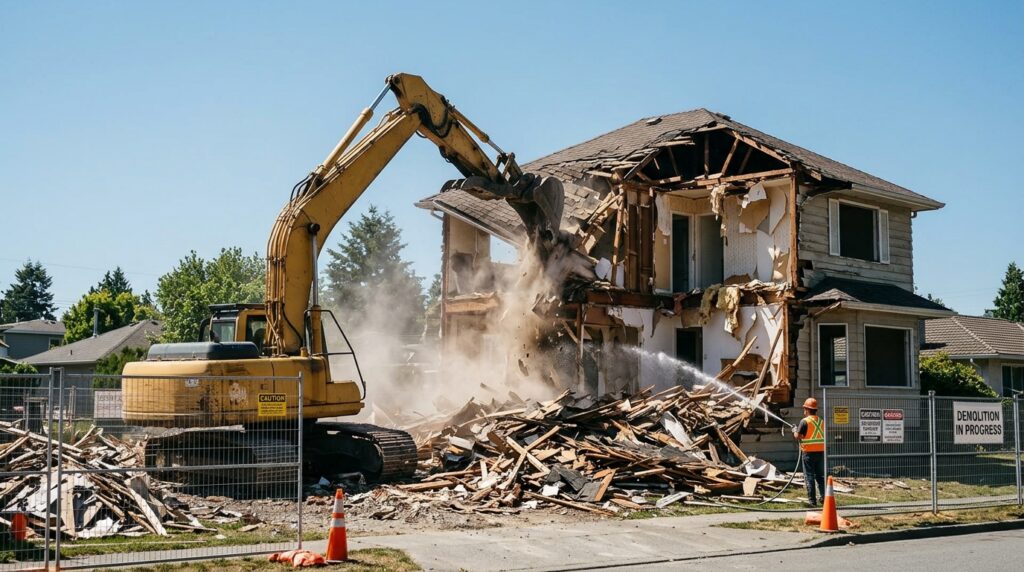
You booked a teardown, the quote looks fair, and then one question hits you. Do they remove the foundation when demolishing a house? In most full demolitions, yes. The final answer depends on your contract, your local permit rules, and what you plan to build on the lot next.
At Demolition Inc, we answer this question on nearly every residential demolition we quote across Tennessee. Many homeowners in Columbia, Franklin, Brentwood, and Nashville assume the concrete leaves with the house. Sometimes it does. Sometimes it stays, and you only find out after the crew drives away. That is why the scope needs to be in writing before the excavator arrives.

This guide breaks down what a standard demolition takes out, what can be left behind, and how to read a quote so nothing surprises you.
Quick Summary
- Do they remove the foundation when demolishing a house? In a full teardown, usually yes.
- A full demolition removes the slab, foundation walls, and footings along with the structure.
- A partial demolition leaves the foundation in place, which can lower the price but limits your options.
- Foundation removal is often priced as a separate line item, so check your quote closely.
- Tennessee requires an asbestos inspection, a state notification, and a call to 811 before work starts.
Do They Remove the Foundation When Demolishing a House? The Short Answer
In a complete teardown, the foundation normally comes out. That includes the concrete slab, the foundation walls, and the footings below them. The goal is a clear, level lot that a builder can use right away.
The word demolition can mean different things, though. Some contractors only take down the structure above ground and leave the concrete behind. Others price foundation removal as an add on. Both approaches are common, so you can’t assume one or the other.
Ask one direct question before you sign: “Is foundation removal included in this price?” The answer tells you a lot about the quote.
What Stays and What Goes in a Typical Demolition
Here is how a standard house demolition usually breaks down.
Usually removed
- Roof, framing, siding, and interior walls
- Floors, subfloors, and ceilings
- Chimneys, porches, and attached decks
- All debris, hauled off site
Removed in a full demolition
- Concrete slab or basement floor
- Foundation walls, whether poured or block
- Footings under the walls
Sometimes left in place
- The entire foundation, when you plan to reuse it
- Driveways, walkways, and patios that are not listed in the scope
- Detached garages, sheds, or other outbuildings that are not in the contract

Full Demolition vs Partial Demolition: Key Differences
Full demolition
- Removes the house, slab, foundation walls, and footings
- Leaves a clean lot ready for new construction
- Costs more upfront because of concrete breaking and hauling
- Gives your builder a clear site to work from
Partial demolition
- Removes only the structure above the foundation
- Leaves concrete walls, footings, and slab on the lot
- Costs less now, but may cost more later if the concrete fails inspection
- Works best when you plan to rebuild on the same footprint
If you are still deciding, think about your next project first. A new home on a new layout almost always needs a clean slate.
How Foundation Type Changes the Job
Not every foundation comes out the same way. The type under your house affects time, equipment, and cleanup.
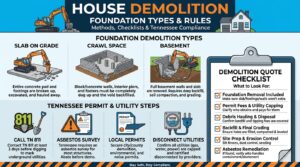
Slab on grade
A single concrete pad sits at ground level. Crews break it into pieces, load it, and haul it away. This is usually the quickest removal.
Crawl space
Short concrete or block walls sit on footings, with open space under the floor. The walls and footings both need to come out. The trenches then get filled and compacted.
Basement
This is the biggest job. Crews break out tall walls and a full floor, then fill a large hole with compacted material. A basement that stays open or gets filled poorly turns into a safety and drainage problem.
Footings explain why removal takes real machinery. According to InterNACHI, footings under the International Residential Code run at least 12 inches wide and 6 inches thick, and they sit at least 12 inches below the ground surface. Many go deeper where frost is a concern. That is solid concrete buried in the soil, and it takes an excavator to pull it out.
Why Most Property Owners Choose Foundation Removal
Most of our customers want the old concrete gone, and the reasons are practical.
- A clear lot gives your builder a fresh start with no surprises under the soil.
- Old foundations can hide cracks, moisture problems, and weak or missing reinforcement.
- Leftover concrete can block new utilities, driveways, or a different floor plan.
- Lenders, surveyors, and builders often prefer a fully cleared site.
Removal also has an environmental upside. The EPA overview of construction and demolition materials lists concrete among the heavy materials in demolition debris. It also notes that recycling these materials saves landfill space and can lower overall project costs.
When Leaving the Foundation Makes Sense
Keeping the concrete is not always a mistake. It can work in a few situations.
- You want to rebuild a similar house on the same footprint.
- An engineer has checked the foundation and confirmed it meets current code.
- The slab or walls are in good shape, with proper drainage and no major cracks.
- Your budget is tight and the savings matter right now.
The risk is what you can’t see. Older foundations may lack reinforcement or proper drainage. A failed inspection means you pay to remove the concrete later, often at a higher cost. Get an engineer’s opinion before you plan around old concrete.
Permits, Utilities, and Asbestos Rules in Tennessee
Foundation work does not happen in a vacuum. Tennessee has a few rules that every demolition must follow.
Tennessee air pollution rules require building owners to have a state accredited inspector check for asbestos before demolition. The same rules call for a notification to the state ten working days before a demolition, even when no asbestos turns up, according to Rutherford County demolition guidance.
Digging has its own deadline. State law requires anyone who excavates, demolition included, to give Tennessee 811 at least three working days of notice. Skipping that call risks damage to buried gas, water, and electric lines.
Local permit offices set their own rules on foundations. Some Tennessee cities and counties require the foundation to be removed and the voids filled. Others allow it to stay if it is covered or approved. So when homeowners ask, do they remove the foundation when demolishing a house, the permit office gets a say too. Our demolition permit checklist walks through each step in order.
How to Read a Demolition Quote
Foundation work is easy to miss in a quote. Look for these items listed separately:
- Slab and foundation wall removal
- Footing removal
- Backfill and compaction of the open space
- Concrete hauling and disposal fees
- Utility disconnects and permit handling
- Final grading of the lot
Foundation removal is often its own line item because breaking and hauling concrete takes excavators, jackhammers, and disposal fees. Pricing in Middle Tennessee shifts with foundation size and site access, so ask for a clear breakdown. A cheap quote that skips the foundation is not a real bargain.
If you only need a driveway, patio, or slab broken out, our concrete removal team handles that as a standalone job.
Common Mistakes to Avoid
- Assuming the foundation is included without asking
- Signing a contract with vague wording like “site cleanup”
- Skipping the engineer when you plan to reuse old concrete
- Forgetting to check local permit rules first
- Ignoring backfill, which leaves an unsafe hole on your property
Need a Teardown in Tennessee?
Demolition Inc serves homeowners, business owners, and contractors across Tennessee. We confirm the foundation scope in writing, handle permits and utility steps, and clear the lot so you can build. Call (615) 290-2029 or request a free estimate today.
Frequently Asked Questions
Do they remove the foundation when demolishing a house?
In most full demolitions, yes. A complete teardown typically includes removing the foundation, footings, and concrete slabs so the lot is cleared for new construction. Some contracts offer partial demolition that leaves the foundation intact, so confirm the scope in writing before work starts.
What stays behind if the foundation is not removed during demolition?
The concrete foundation walls, footings, and slab remain on the lot. Above grade structures like walls, roofing, and framing come down. Leaving the foundation can save money but may limit future building options if the existing concrete does not meet current code requirements.
How much does foundation removal add to a demolition project in Middle Tennessee?
Foundation removal is often a separate line item from the main teardown. Breaking up and hauling concrete requires excavators, jackhammers, and disposal fees. Middle Tennessee pricing varies by foundation size and site access, so ask your contractor for a breakdown that clearly lists foundation work.
Can I keep the existing foundation and build a new house on top?
Sometimes, but only after an engineer verifies the foundation meets current building codes and can support the new structure. Older foundations may lack proper reinforcement or drainage. Reusing a foundation saves money only when the concrete passes inspection and suits your new home design.
Does a demolition permit in Tennessee require foundation removal?
Local rules vary by city and county. Some Tennessee jurisdictions explicitly require foundations to be removed and voids filled during demolition, while others allow leaving them if covered or approved. Always check your local permit office before signing a demolition contract.
Final Thoughts
So, do they remove the foundation when demolishing a house? Usually yes, when the job is a full teardown. But usually is not a promise. Your contract, your permit office, and your building plans all decide what happens to the concrete.
Get the foundation scope in writing, check your local rules, and ask for a line by line quote. If you want a straight answer for your property, call Demolition Inc at (615) 290-2029 or Book online. We will walk the site, explain your options, and give you a free estimate with the foundation work clearly listed.