Quick answer: Before a house comes down in Middle Tennessee, line up four things in this order. Get the local demolition permit from your city or county, arrange an asbestos inspection and file the state notice where it applies, have every utility disconnected, and contact Tennessee 811 at least three working days before any digging. The state notification form asks for at least 10 working days of notice, so the paperwork usually takes longer than the teardown itself.
Most delays on a house demolition have nothing to do with the machines. They come from a missing permit, a utility that is still live, or a notice that was filed a few days too late. We handle residential demolition across Columbia, Franklin, Spring Hill, Thompson’s Station, Mount Pleasant, and the surrounding towns, and this is the checklist we walk owners through before a job is scheduled. Rules change, and every property is different, so treat this as a planning guide and confirm the details with the offices named below.
Step 1: Confirm the Local Demolition Permit
Permits are issued by the city if the property is inside city limits, or by the county if it is not. Each office has its own forms, so start by confirming which one covers your address.
Columbia
The City of Columbia lists Demolition under Structure Permits on its online permitting portal. The city’s building permit application also asks for a copy of a current State of Tennessee contractor’s license when the project valuation is over $25,000, plus a certificate of workers’ compensation insurance naming the City of Columbia as certificate holder. Development Services is at 700 North Garden Street and can be reached at (931) 560- 1560.
Spring Hill
The City of Spring Hill’s building codes FAQ says permits are required when an owner or authorized agent intends to construct, alter, repair, move or demolish a building or structure. It lists outdoor sheds among its examples of projects that need permits, and it invites questions at (931) 451- 0940.
Franklin and historic districts
In Franklin, properties inside the Historic Preservation Overlay District need a Certificate of Appropriateness from the Historic Zoning Commission for partial or wholesale demolition of buildings, structures or historic site features. The city’s preservation page encourages applicants with demolition proposals to attend a Design Review Committee meeting before applying. If your house sits in or near a historic district anywhere in the region, ask about historic review first, because it can add weeks.
Unincorporated areas and smaller towns
For rural properties outside city limits, or in towns such as Leiper’s Fork, Chapel Hill or Summertown, call the county or town building office before you set a date. Ask whether a permit is required, what it costs, what they need from you, and whether they require proof that utilities are disconnected.
Step 2: Asbestos Inspection and the State Notice
The federal asbestos rule, known as the Asbestos NESHAP, requires a thorough inspection before demolition of regulated buildings and a notice to the state agency before any demolition. According to the EPA overview of the Asbestos NESHAP, the rule excludes residential buildings with four or fewer dwelling units. EPA also explains that houses demolished as part of a commercial or public project, such as clearing homes for a highway, a shopping center or another private development, are not exempt.
In Tennessee, the notice goes to the Department of Environment and Conservation, Division of Air Pollution Control. The state’s Notification of Demolition and/or Asbestos Renovation form says it is required for all demolition projects, even if no asbestos is present, and must be submitted at least 10 working days before work begins. A few details on that form trip people up:
- Holidays that fall Monday through Friday count as working days. Saturdays and Sundays do not.
- If the start date changes, you must file a revised notice, delivered no later than the original start date and at least 10 working days before the new one.
- The form asks whether asbestos is present and requests a copy of the inspection report.
Whether a single-family teardown on its own lot needs the state notice is a question to settle with TDEC before you schedule, not after. Even where the rule does not apply, an inspection is cheap insurance. It tells the crew what they are dealing with before any machine touches the structure, and it protects you, your neighbors and the workers on site.
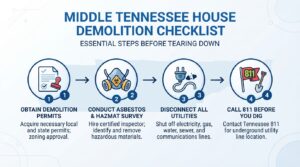
Step 3: Disconnect and Cap Every Utility
A house cannot be demolished safely while electric, gas or water service is still connected. Call each provider early, because scheduling a disconnect or meter removal can take time. Make a list that covers:
- Electric service and the meter.
- Natural gas, or propane tanks and lines if the house used propane.
- Water service and sewer, or the septic system on rural lots.
- Phone, cable, and internet lines.
- Private lines you own, such as power or water running to a detached garage, barn or well house.
Ask your permit office whether it needs written confirmation of each disconnect before it issues the permit or schedules an inspection. Keeping those confirmations in one folder saves a return trip.
Step 4: Contact Tennessee 811 Before Any Digging
Tennessee’s Underground Utility Damage Prevention Act (TCA 65-31-101) requires anyone planning or performing excavation to give Tennessee 811 at least three full business days’ notice. Tennessee 811 lists demolition among the activities that count as excavation, alongside grading, boring and hand digging. You can dial 811, call (800) 351- 1111, or submit a ticket online.
Two things matter here. First, Tennessee 811 notes that normal notice is 72 hours excluding weekends and holidays, which is a different count from the state asbestos form. Second, member utilities mark only the lines they installed or maintain, and not every utility is a member. Private lines, such as the power feed to a shop or the water line to a barn, will not be marked by 811, so point them out to your contractor.
Starting October 1, 2026, Tennessee 811 is reducing the automatic notification buffer it draws around a mapped dig area from about 343 feet to 200 feet. The buffer is based on the location details you give when you place the ticket, so describe the demolition area clearly and completely.
Step 5: Plan Access, Debris and the Finished Site
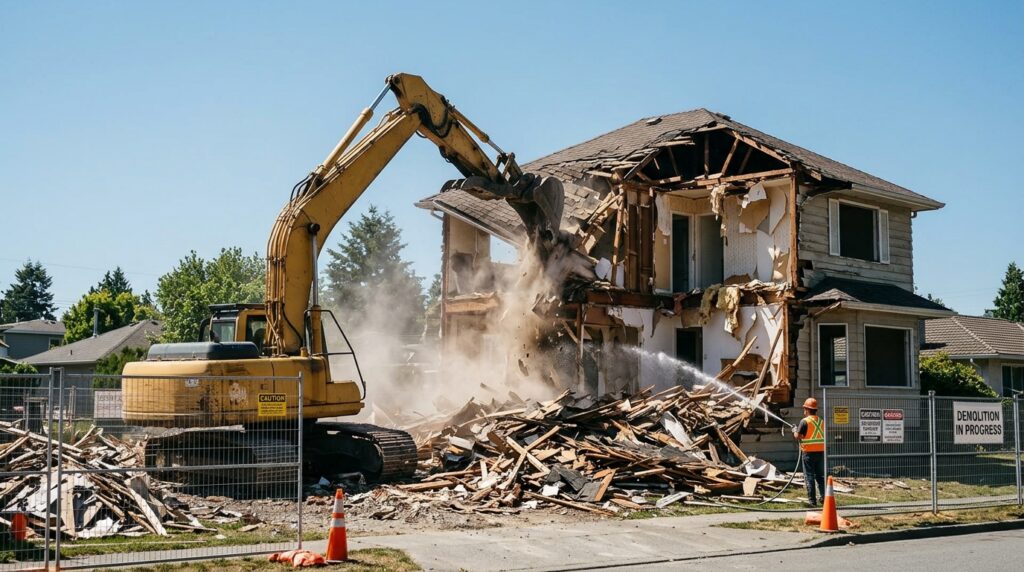
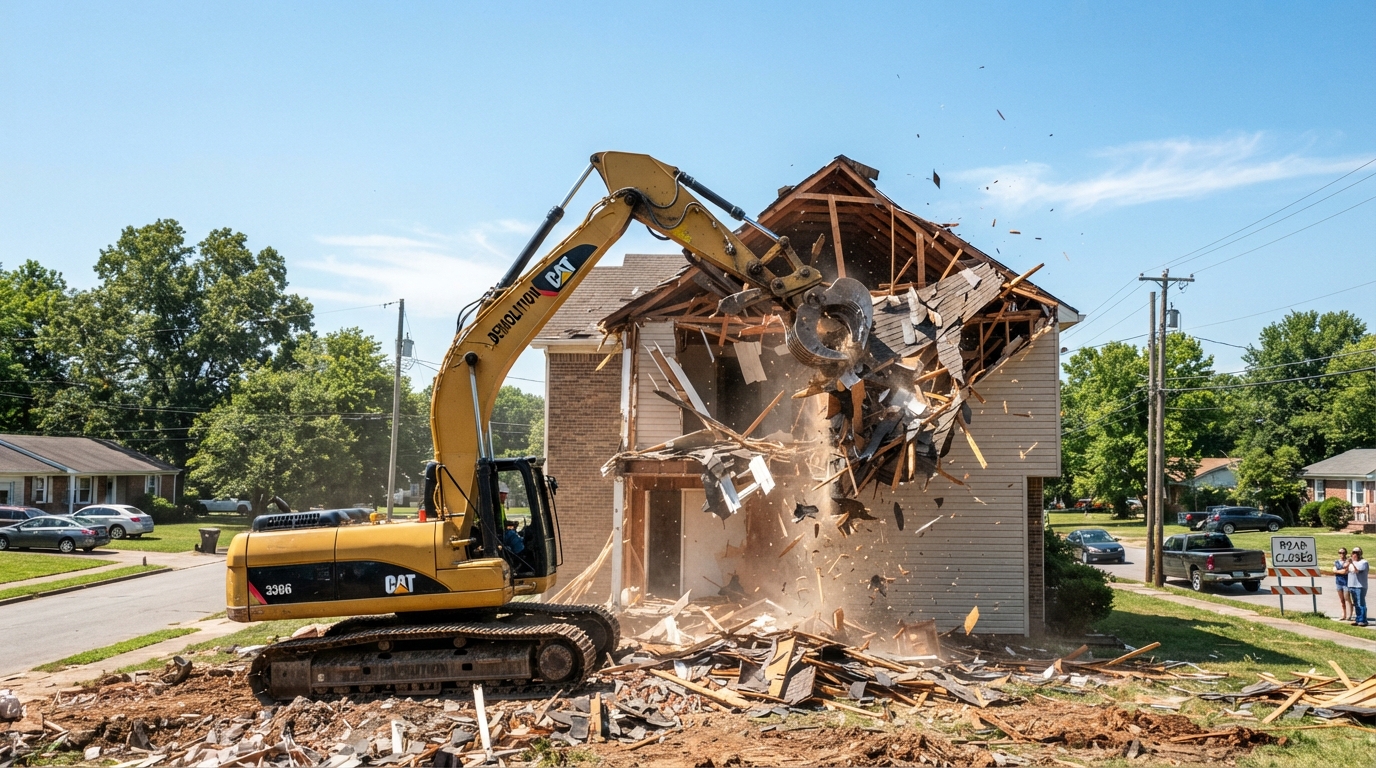
With paperwork and utilities handled, the practical questions come next. Where will the excavator and trucks enter? Does the driveway need protection? What happens to the foundation, the basement and any concrete flatwork? Should trees near the house stay? Our Franklin residential home demolition project shows the sequence in practice: heavy equipment access, controlled breakdown of the structure, debris handling and cleanup, leaving the site clear for the owner’s next step.
If you are clearing a commercial property instead, the planning is heavier and the asbestos rule applies to any institutional, commercial, or industrial building. Our post on what makes commercial demolition different covers the basics, and you can see the full range of work on our demolition services page.
A Realistic Timeline, Including the Holidays
Every project is different, but the order rarely changes. Here is how the steps usually stack up:
- Week one: confirm who issues your permit, book the asbestos inspection, and call your utility providers.
- Once the inspection report is in hand: apply for the permit and, where required, file the state notice at least 10 working days before the planned start.
- While the notice period runs: complete disconnects and collect confirmations.
- At least three working days before work begins: place your Tennessee 811 ticket and check that every utility has responded.
- Demolition day and cleanup: the structure comes down, debris is hauled and the site is left ready for what comes next.
Year-end needs extra attention. Thanksgiving falls on Thursday, November 26, 2026, and Christmas Day on Friday, December 25. Both count as working days on the state asbestos form, but Tennessee 811 excludes holidays from its count, and many offices close. If you want a lot cleared before the new year, start the paperwork in October or early November.
For a look at what happens once the crew arrives, read our short overview of how residential demolition works.
Frequently Asked Questions
Do I need a permit to demolish a house in Middle Tennessee?
In most cities, yes. Columbia lists demolition permits on its online portal, and Spring Hill requires permits to demolish a building or structure. Outside city limits, check with the county building office before you schedule work.
Does Tennessee require notice before demolishing a house?
The TDEC demolition and asbestos renovation form says it is required for all demolition projects, even if no asbestos is present, at least 10 working days before work starts. Federal rules exclude residential buildings with four or fewer units in some cases, so confirm your situation with TDEC.
Do I need an asbestos inspection before demolition?
For commercial, institutional, and industrial buildings, and for houses cleared as part of a larger development, federal rules require a thorough inspection. For a single home, an inspection is still a smart step because it identifies materials that need special handling.
How far ahead should I call 811 before demolition?
Tennessee law requires at least three full business days’ notice before excavation, and Tennessee 811 lists demolition as excavation. You can give up to 10 working days’ notice if your schedule is flexible.
Who disconnects the utilities before a house is torn down?
Each utility provider disconnects its own service, usually at the owner’s request. Call electric, gas, water, and sewer providers early, and ask your permit office whether it needs written confirmation.
Does Franklin have extra rules for demolition in historic districts?
Yes. Inside Franklin’s Historic Preservation Overlay District, partial or wholesale demolition needs a Certificate of Appropriateness from the Historic Zoning Commission, and the city encourages a Design Review Committee meeting first.
Can Demolition INC help with the demolition itself and site cleanup?
Yes. Residential demolition, structure removal, concrete removal, and site clearing are all listed services, and every job ends with debris removal so the property is ready for the next phase.
Plan Your House Demolition With Demolition INC
If you are planning a teardown anywhere from Columbia and Spring Hill to Franklin, Pulaski, or Dickson, we can review the structure, the site, and your timeline and give you a clear estimate. Call +1 (615) 290 2029 or send your project details through our contact page. The estimate form notes a response within one business day. You can also learn more about Demolition INC and browse our recent projects.